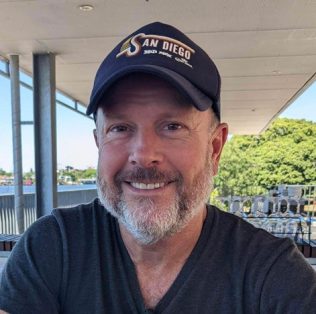
Martin is the Chair of the SCRFA Board of Directors, based in Brisbane, Australia.
Martin has been working for over 26 years on marine protected area (MPA) and fisheries management in Australia. He is the Manager of the Coral Sea Marine Park in the Australian Government and worked previously as a fisheries/MPA manager with the Great Barrier Reef Marine Park Authority.
He is a former Chair of the Gulf and Caribbean Fisheries Institute (GCFI) Board of Directors and is involved in other organisations including the International Coral Reef Initiative. Martin has an applied science degree in fisheries and has extensive research and management experience working on fish spawning aggregations, coral and reef fish in Asia-Pacific and Caribbean.
He has been a SCRFA Board member since its inception in 2000, and Chair of Board since 2004. A key project Martin is working on for SCRFA is the Global Fish Aggregation Database.
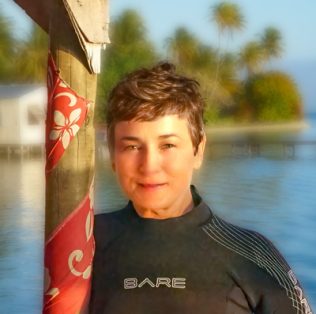
Yvonne is Executive Director of SCRFA, and a founding Board member, formerly based for 30 years in Hong Kong and now settling into England.
Yvonne gained her PhD at the University of Manchester in England. She took up Directorship of the Puerto Rico government Fisheries Research Laboratory and worked with the Caribbean Fishery Management Council. In 1993 Yvonne went to the University of Hong Kong's Division of Ecology & Biodiversity, School of Biological Sciences, where she was a professor for 30 years. She taught Fish Biology, Fisheries and Mariculture, Marine Biology and Conservation Ecology, among other courses and supervised masters and doctoral students. Yvonne is one of the founding members of SCRFA and the co-Chair of the International Union for Conservation of Nature (IUCN) Specialist Group of Groupers & Wrasses, which she founded. She is a Marine Advisor to The Swire Trust in Hong Kong.
Yvonne has worked variously on the biology, management and conservation of reef fishes for over 40 years and has produced over 200 publications (>130 peer-reviewed), written or co-edited 7 books, and appeared on multiple media including BBC’s Blue Planet series 1 and 2. She has a long-standing interest in reproductive biology, especially the relationship between mating systems and vulnerability to fishing, with a particular emphasis on groupers, spawning aggregations and sex-changing species.
Rick is recently retired from The University of the Virgin Islands (UVI) Center for Marine and Environmental studies where he conducted research on fish ecology and conservation for 28 years.
Rick earned Bachelor of Science and Masters of Science degrees in Fisheries from Humboldt State University and University of Washington before receiving his PhD in Zoology in 1996 from the University of New Hampshire under the guidance of Dr. Peter Sale. Following his PhD, which focused on the recruitment patterns of the bicolor damselfish in the Virgin Islands and Jamaica, he served as resident director of the Hofstra Marine Lab, in St. Ann’s Bay, Jamaica.
In 1997 he started as research assistant professor at the University of the Virgin Islands in St. Thomas and in 1999 Rick was appointed founding director of UVI’s Centre for Marine and Environmental Studies. From 1999 to 2012 he expanded UVI’s research infrastructure and diving programme to include technical nitrox and closed circuit rebreathers as well as established the Master’s in Marine and Environmental Science graduate programme in 2007. In 2013 he was promoted to Research Professor and returned to full time research and mentoring of graduate students. During his tenure at UVI’s Center for Marine and Environmental Studies he published over 70 peer-reviewed publications, 6 book chapters, and 9 scientific reports. His research covered a broad range of topics in fish ecology but focused primarily on the conservation and management of reef fish spawning aggregations. This work was instrumental in establishing the Grammanik Bank seasonal closed area which protects a multi-species spawning aggregation site in the USVI and has led to an increase in the endangered Nassau grouper in the Virgin Islands.
Currently Rick is using autonomous underwater robots and AI to monitor the recovering Nassau grouper spawning population. His research used acoustic telemetry and other technology to determine spatial and temporal patterns of movements of aggregating species (groupers, snappers, triggerfish, parrotfish) during spawning as a means of identifying biologically relevant boundaries for protecting spawning aggregation sites. He also used acoustic telemetry to understand the movement patterns of other species (tarpon, lionfish, stingrays and sharks) in relation to ecological and environmental change. He has conducted this research throughout the Caribbean and tropical Pacific including US and British Virgin Islands, Puerto Rico, Bermuda, Bonaire, Netherland Antilles, Pohnpei, Fiji and French Polynesia.
Jan obtained his PhD from James Cook University, Australia, studying the management implications of fisheries that exploit fish aggregating behaviour, and is the author of over 35 peer-reviewed scientific articles. With a scientific background, Jan coordinated research in Seychelles and the Indian Ocean that focused on coral reef ecology, climate change and fisheries management. He has also chaired numerous scientific bodies for Regional Fisheries Management Organisations.
Jan has worked in the fields of fisheries research and management at national and regional levels in the western Indian Ocean for over 25 years, with experience ranging from small-scale reef fisheries to industrial tuna fisheries. He was appointed CEO of the Seychelles Fisheries Authority (SFA) in 2023, having previously led fisheries research at SFA between 2001 and 2011.
In recent years, Jan was the Project Manager of the World Bank’s Third South-West Indian Ocean Fisheries Governance and Shared Growth Project, which supported marine spatial planning, improved fisheries governance and investment in Seychelles’ blue economy, and was part-financed by the proceeds of the World’s first sovereign Blue Bond. In addition to mobilising finance and leading public sector projects, Jan has worked effectively with industry in managing fisheries improvement and sustainability certification projects for fisheries in the Indian Ocean.
Kevin is a Research Associate with Auckland University of Technology and a specialist with the IUCN Red List Groupers Specialist Group. Kevin earned a Bachelor of Science degree in Aquatic Biology from the University of Texas at Austin, a Master of Science degree in Marine Science from California State University at Hayward and a PhD in Ecology and Biodiversity from the University of Hong Kong. His dissertation was entitled “Reproductive biology and population genetic structure of the camouflage grouper, Epinephelus polyphekadion, and its management implications".
Kevin is an active research scientist in tropical reef fish biology and fisheries ecology. His primary research focus is tropical reef fish reproduction, fish life history, conservation biology and fish spawning aggregation dynamics. Recent and past research includes the identification of spatial habitat requirements for elasmobranchs and aggregating bony fish for MPA design, and fish market and life history analyses with a focus on improving market-based and fisheries management. He provides technical training and scientific support to governments and fisheries management units throughout the Caribbean and central and western Pacific. He has helped to form fishers’ cooperatives in the Pacific and develop value-adding opportunities and sustainable fish markets to improve fisher income and as alternative livelihoods to fishing.
Dr Rhodes has authored and published numerous articles on fisheries management, the biology and behaviour of reef fishes, including a number of species that aggregate to spawn, and has co-authored training manuals for spawning aggregation monitoring and management. Dr. Rhodes is currently collaborating with the Wildlife Conservation Society to document and characterize the Solomon Islands nearshore and reef fisheries, conducting research on rabbitfish life history and assisting local NGOs in Micronesia develop stakeholder-driven fisheries management plans. During his spare time, Kevin works with researchers at NASA and SETI on the ecology of extremophilic cyanobacteria in the world’s hyperarid deserts as analogs to Mars and Mars rover development.
Dr Brian Luckhurst (Retired: Bermuda Fisheries)
Dr Rick Hamilton (The Nature Conservancy)
Dr Sebastian Troeng (Conservation International, USA)
Dr Terry Donaldson (University of Guam)
Dr Janet Gibson (Wildlife Conservation Society, Belize
Dr Michael Domeier (CSI Marine, Hawaii)
Dr Pat Colin (Coral Reef Research Foundation, Palau)
Dr Ken Lindeman (Florida Institute of Technology)
Dr. Brad Erisman (University of Texas at Austin)
Dr. Enric Sala (Wildlife Conservation Society and National Geographic)